
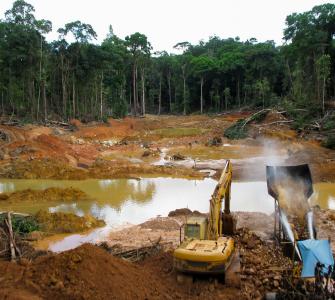
Conservation Strategy Fund (CSF) 's Mining Impacts Calculator (MIC) is a technical tool designed to estimate the environmental, social, and economic impacts of artisanal and small-scale gold mining (ASGM). In the Amazon, ASGM is a major driver of deforestation, mercury contamination, biodiversity loss, and harm to the health and livelihoods of Indigenous Peoples, riverine populations, and other local communities. The Calculator was developed to help public institutions and other stakeholders quantify these impacts more consistently and use evidence to support environmental governance, accountability, and decision-making.
CSF serves as the technical lead behind the Mining Impacts Calculator. We develop and refine the methodology, adapt the tool to national legal, ecological, and institutional contexts, and train key stakeholders in its application. Our role includes working with government agencies, justice-sector institutions, civil society organizations, and local communities to strengthen their ability to assess the impacts of gold mining and use that information in enforcement, environmental damage assessments, and policy processes.
This tool was originally developed for the Brazilian government in 2021 and has been helping the government better protect local communities from the negative impacts of gold mining across the country.
In 2022, with support from the Amazon Sustainable Landscapes Program, CSF expanded this work in Brazil, Colombia, and Peru by adapting the Calculator to the Colombian and Peruvian contexts and strengthening institutional capacity for its use.
In parallel, CSF was a finalist for the Conservation X Labs' Artisanal Mining Grand Challenge: The Amazon for an Ecuador-focused adaptation of the Calculator. By 2023, with the support of the United States Agency for International Development (USAID), CSF expanded the Calculator’s methodology for use in Guyana and Suriname, while also promoting its formal uptake in government institutions in Ecuador.
Between 2024 and 2025, the Gordon and Betty Moore Foundation and Fundación para la Conservación y el Desarrollo Sostenible (FCDS Peru) supported CSF's work to expand theCalculator’s scope in Peru to cover the Amazonian departments of Amazonas, Ucayali, Huánuco, and San Martín, in response to the spread of illegal mining into these areas. Initially, the tool only covered the regions of Loreto and Madre de Dios. Additionally, to facilitate its practical application by Peru’s Office of the Attorney General, CSF incorporated into the economic valuation methodology the costs associated with the remediation of mercury-contaminated sediments in water bodies, as well as a new unit of analysis related to the productivity generated by the machinery and/or equipment used in illegal mining (alluvial and/or fluvial). As part of the tool’s adaptation and a formal cooperation agreement between CSF and the Office of the Attorney General, more than 200 members of the institution—including attorneys, technical experts, and judges—were trained to strengthen their capacity to apply the Calculator in environmental damage assessments.
The Amazon Sustainable Landscapes Program later renewed its support for CSF to adapt the Calculator to the Bolivian context. This work included the incorporation of a dedicated unit of analysis to estimate impacts when mining takes place inside protected areas, as well as training and capacity-building activities for local stakeholders. To demonstrate the methodology in practice, the Calculator was applied in three pilot cases: a national protected area, a transboundary protected area, and a non-protected zone with significant mining activity that uses mercury.
Across countries, CSF’s core deliverables include country-adapted versions of the Mining Impacts Calculator; updated economic valuation methodologies tailored to national contexts; training workshops and technical guidance for government, justice-sector, and civil society users; pilot applications that demonstrate the Calculator’s practical value; and institutional partnerships that support formal uptake of the tool in assessment, enforcement, and decision-making processes.
With the addition of Guyana, Suriname, Ecuador, Colombia, and Bolivia, and with the updated methodology in Peru, the Mining Impacts Calculator now supports a growing regional effort to make the costs of destructive mining more visible and measurable across the Amazon. By using a common framework across countries, the Calculator can help improve comparability of assessments, strengthen accountability, discourage mercury use, and support cleaner and less destructive mining practices.
Over time, CSF aims for the Calculator to be used independently and consistently by government agencies, justice operators, civil society organizations, and local communities. The longer-term goal is for the MIC to become an institutionalized tool that supports stronger environmental governance, more robust environmental damage assessments, better protection of forests and freshwater ecosystems, and more just and sustainable development pathways for Amazonian communities.
Visit the MIC website here.
______
Thank you to our partners at the United States Agency for International Development (USAID), the Gordon and Betty Moore Foundation, the World Bank's Amazon Sustainable Landscapes Program, and Fundación para la Conservación y el Desarrollo Sostenible for supporting the expansion of this tool.