
Background: A Region of Deep Tradition and Rich Resources
Located in West Kalimantan, Sintang Regency spans 21,000 square kilometers—an area holding 1.3 million hectares of forest and vital freshwater systems. It is home to over 438,000 people, including Dayak and Malay communities who maintain a spiritual philosophy of Hamparan Hati (living in harmony with nature). Despite these assets, development pressures from palm oil and infrastructure have threatened the local ecosystem.
With the rise of increased government regulations to support more sustainable commodity-sourcing and advance the Sustainable Development Goals, a number of regencies and provinces in Indonesia have taken steps to embrace sustainable and low-carbon development plans. In 2016, Sintang’s leadership declared a bold vision to become Sintang Lestari (Sustainable Sintang). Since 2018, Conservation Strategy Fund (CSF) Indonesia—locally known as Yayasan Strategi Konservasi Indonesia (YSKI)—has supported this transition by providing the economic expertise and strategic planning necessary to turn this vision into policy.
Over six years of work together, CSF contributed expertise in economics, sustainable development, and strategic planning while working closely with the local government and local civil society organizations (CSOs) within West Kalimantan, Sintang Regency.
The Three Phases of Strategic Impact
Phase 1: Strengthening the Foundation (2018–2019) YSKI co-created a unified roadmap through multistakeholder dialogues and baseline studies on local history, economics, and land governance.
- Formalized Regent Regulation No. 66/2019, the Regional Action Plan for Sustainable Development (RAD-SL). This shifted institutional mindsets, demonstrating that ecological preservation and economic growth are inseparable.
Phase 2: Building Commitment and Capacity (2019–2021) With a policy framework in place, YSKI delivered over ten specialized trainings to government planning agencies (BAPPEDA), Indigenous leaders, and civil society.
- Aligned the Sintang Lestari vision with the 2021–2026 Regional Mid-Term Development Plan (RPJMD). Technical studies like Growth Diagnostics provided evidence for the District’s General Investment Plan (RUPM).
Phase 3: Strengthening Strategic Sectors (2022–2024) The final phase focused on sector-specific implementation in infrastructure, freshwater fisheries, and green budgeting.
- In March 2022, we held a public consultation on the Sintang General Investment plan in collaboration with the Sustainable District Association (LTKL) and the Sintang One-Stop Integrated Services and Investment Agency (DPMPTSP)
- In July 2022, we held the Green Sintang Initiative with Green Budget Tagging Training. The training was part of the ongoing collaboration with the Sintang Development Planning Agency (BAPPEDA) involving the local stakeholders on the practice of identifying district budget elements that align with the Green Sintang Vision.
- In August 2022, we held the first Green Budget Tagging Working Group Assembly. As part of the Green Budget Tagging training, CSF Indonesia and the Sintang’s BAPPEDA formed a working group to conduct a Groundwork Analysis of the Green Budget Tagging.
- In September 2022, we hosted a sustainable landscape modeling training with Sintang’s Land and Spatial Department to improve Sintang the Department capacity for the use of Landscape Modelling in understanding land-based economic activities.
- In January 2023, we facilitated a Sintang Green Budget Tagging (GBT) Working Group Public Dissemination. As the groundwork analysis of the GBT reached its end, the working group, together with Sintang’s Development Planning Agency, held its public dissemination of green budget tagging facilitated by the CSF Indonesia team. Green budget tagging involves classifying budget measures according to their environmental and/or climate impact.
- In June 2023, alongside USAID Segar and WWF-Indonesia, we began our effort to support the Sintang Spatial Planning Revision. This revision will make sure that Sintang could have its sustainable planning embedded into the Spatial Plan currently in development.
- December 11, 2024: Hosted "Kolaborasi untuk Bumi" (Collaboration for the Earth), a final event to celebrate the six-year journey and launch the project report book.
Final Reflections: Mindset Change as the Cornerstone
YSKI’s work has proven that sustainable development is about more than just numbers; it is about building a culture of collaboration. Through rigorous economic analysis and the integration of local values, Sintang now serves as a global model for how district governments can safeguard both people and nature.
Project Recognition: YSKI’s six-year contribution was formally recognized by the Sintang District Government with multiple awards in Good Governance and Research & Development.
“CSF/YSKI’s contribution in Sintang... has complemented the work of other development partners. Their support was instrumental in facilitating the adoption of the Sintang Lestari Regional Action Plan.” — WWF Indonesia
__________________________________________________________________
This work was funded by The David and Lucile Packard Foundation.
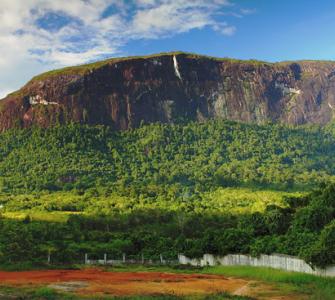
Photo: Mount Kelam, Sintang Regency, West Kalimantan
Photo credit: Nizar Kauzar