
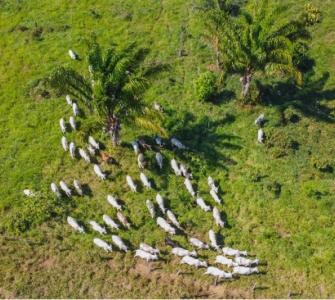
The livestock sector is one of the main drivers of deforestation in the Ecuadorian Amazon. This practice, though dangerous to the rainforest, is an important source of financial freedom, and employs a substantial number of Ecuadorian households and indigenous communities. Agriculture accounts for nearly 10% of Ecuador’s GDP (World Bank Group), and any changes in this sector must account for this financial significance.
Conservation Strategy Fund (CSF) and Conservation International investigated the production systems of the livestock sector in the Ecuadorian Amazon and proposed a transition to sustainable practices in the livestock sector that would continue to support the region economically while reducing environmental harm.
CSF used its expertise in conservation finance to develop strategies for more sustainable business and agricultural practices in Ecuador. CSF’s analysis accounted for the value chains, key actors, transportation methods, and costs and benefits of the livestock sector to provide research-based recommendations for more sustainable value chains. As a part of this project, CSF and CI identified the financial requirements necessary for any transition in the sector and evaluated the most suitable financial instruments to achieve the transition.
Key Outputs:
- Report with summary of initiatives and economic studies
- Simplified map of value chains
- Report with identification of key actors and comparison of transition costs and benefits.
- Report with cash flows, cost-benefit analysis, sensitivity analysis and distributive analysis
- Report with extrapolation of results to the scale of the Ecuadorian Amazon and comparison of costs and benefits.
- Report with evaluation of financial instrument
_______
This project was completed due to the funding from, and in partnership with, Conservación Internacional Ecuador.