
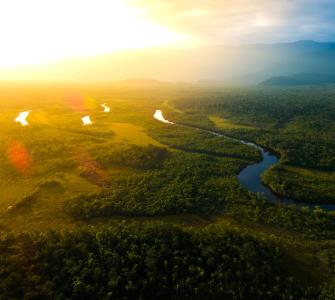
Facing rapid rates of deforestation and increased land grabbing, Brazil faces an uphill battle to protect the Amazon rainforest while prioritizing development and livelihoods for its population. New opportunities exist for Amazon rainforest conservation through mechanisms such as Reducing Emissions from Deforestation and Forest Degradation in Developing Countries (REDD+) under the UNFCCC, but supportive public policies, institutional capacity, and effective economic incentives remain essential to advancing sustainable development in the region.
Conservation Strategy Fund (CSF)-Brazil, in partnership with the Amazon Environmental Research Institute (IPAM) and with funding from the Norwegian Agency for Development Cooperation (Norad), worked on a five-year initiative to provide technical recommendations aimed at (1) supporting efforts to combat illegal deforestation, (2) improving territorial governance and the identification and management of land-tenure and socio-environmental risks, (3) creating enabling conditions for sustainable investments, and (4) promoting production chains, deforestation-free and low-carbon agricultural supply chains in the Amazon.
In economic incentives and environmental policy, CSF supported the development of policies and economic instruments to promote forest conservation and expand access to financing opportunities. Through technical assessments and policy recommendations, the team examined mechanisms such as jurisdictional REDD+, payments for environmental services, and ecological fiscal transfers. This work included evaluating regulatory and institutional barriers, assessing opportunities in carbon markets, and exploring ways to recognize the social and biodiversity benefits of forest conservation. CSF also contributed recommendations to improve Maranhão's Ecological ICMS, including criteria related to environmental regularization, transparency, and municipal management capacity.
In sustainable production and territorial planning, CSF and IPAM developed the Jurisdictional Sustainability Index, integrating 35 environmental, socioeconomic, governance, and agricultural production indicators across four thematic dimensions to assess sustainability at the municipal level in Maranhão and Pará. Available through an interactive dashboard, the index enables comparisons across territories and provides evidence to inform public policies, investment decisions, and the identification of priority areas for territorial interventions. Its applications included the soy supply chain in Maranhão and the cocoa supply chain in Pará. The project also contributed technical recommendations to the Maranhão 2050 Plan, emphasizing territorial differences, environmental regularization, climate risks, and local governance.
In capacity development and knowledge sharing, CSF supported training programs, participatory workshops, and technical exchanges involving state governments, producers, community organizations, and other stakeholders. These activities helped build technical capacity and facilitate dialogue on economic instruments, environmental asset management, carbon markets, and sustainable production. Engagement with local actors, including the Rural Development Committee of the Chapadinha Microregion in Maranhão, helped connect technical approaches with territorial priorities. CSF and IPAM also produced a five-video series highlighting local experiences in sustainable production and territorial governance.
Together, these contributions provided governments, financial institutions, businesses, and local stakeholders with technical evidence, practical tools, and policy recommendations to better align economic development, forest conservation, and local needs across the Brazilian Amazon.
Photo: Amazon Rainforest in Brazil
Photo Credit: Gustavo Frazao/ Shutterstock.com