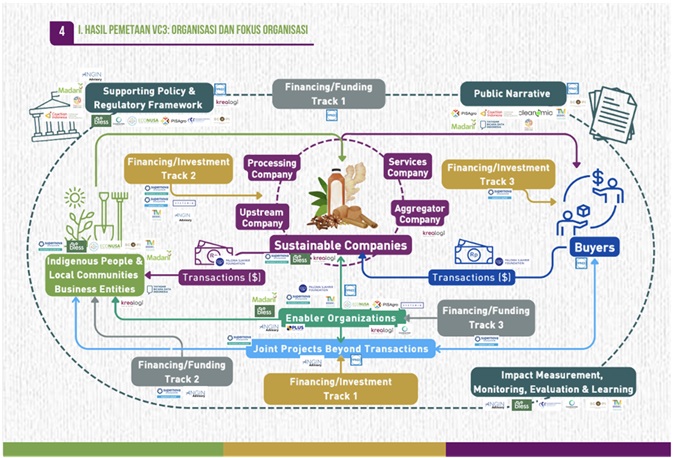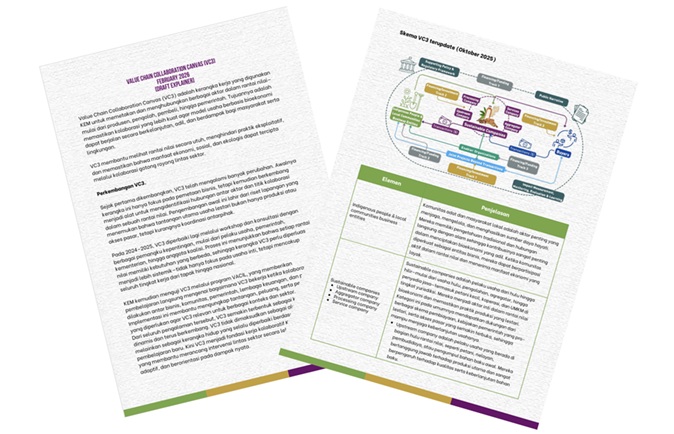
Koalisi Ekonomi Membumi (KEM) was established to accelerate the development of a sustainable and inclusive bioeconomy ecosystem in Indonesia. As the coalition grew, it became clear that many sustainable business initiatives faced challenges not only in production, financing, or market access, but also in coordinating and aligning the diverse actors involved across the value chain. These gaps in collaboration often limit opportunities for value creation, investment readiness, and long-term sustainability. To address these challenges, KEM developed the Value Chain Collaboration Canvas (VC3), a collaborative framework designed to strengthen connections among businesses, communities, financiers, government agencies, and other ecosystem actors while fostering shared environmental, social, and economic outcomes.
CSF Indonesia is supporting KEM by documenting and systematizing the VC3 framework, its evolution, implementation experiences, and governance mechanisms. Through research, literature reviews, and interviews with the KEM Secretariat and key ecosystem actors, CSF is helping transform VC3 into a clear and accessible knowledge resource that can be understood and applied by a wider audience. CSF's role is to capture lessons learned, strengthen institutional memory, and provide practical guidance for future users of the framework.
The project will produce two complementary knowledge products:
- VC3 Primer: Understanding Value Chain Collaboration, an introductory handbook that explains the origins, concepts, and lessons learned behind VC3 for public audiences and development partners.
- VC3 Implementation Guide for the KEM Ecosystem, a practical handbook that provides detailed guidance on stakeholder roles, governance arrangements, coordination mechanisms, and operational application of the VC3 framework within KEM's ecosystem.
Together, these documents will serve as foundational references for understanding and implementing collaborative value-chain approaches within Indonesia's sustainable bioeconomy sector.
Following the completion of CSF's engagement, we hope that the VC3 framework will be widely adopted and consistently applied across KEM's network of members, partners, and initiatives. The documentation is intended to become a living resource that continues to evolve as new experiences and lessons emerge. Ultimately, we hope the framework supports stronger collaboration among ecosystem actors, encourages collective problem-solving, and enables more strategic, scalable, and impactful sustainable business initiatives throughout Indonesia.
The broader goal of this initiative is to strengthen Indonesia's bioeconomy by promoting collaborative approaches that generate positive outcomes for people, nature, and local economies. By improving coordination across value chains and encouraging shared responsibility among stakeholders, VC3 aims to support biodiversity conservation, sustainable livelihoods, responsible investment, and inclusive economic growth. The framework contributes to KEM's vision of fostering a regenerative economy that is rooted in Indonesia's rich natural resources, local knowledge, and long-term environmental sustainability.
The project is made possible through the support and partnership of Koalisi Ekonomi Membumi.