
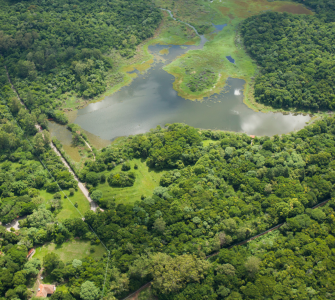
Rio de Janeiro is home to some of the Atlantic Forest's richest biodiversity, but growing pressures on natural ecosystems and limited financial resources pose significant challenges to conservation and restoration. To address these challenges, the state is implementing its State Biodiversity Strategy and Action Plan (Estratégia e Plano de Ação Estadual para a Biodiversidade, EPAEB-RJ), which establishes priorities for conservation, restoration, and sustainable use.
The project aims to strengthen biodiversity financing in Rio de Janeiro by assessing current spending, identifying financial needs and funding gaps, and improving how resources are allocated. It will also identify, evaluate, and prioritize public and private financing solutions to support the state strategy and advance long-term conservation efforts.
As part of the project “Integrated Management of Atlantic Forest Landscapes in Rio de Janeiro”, implemented by the United Nations Development Programme (UNDP) and executed by the Rio de Janeiro State Secretariat for Environment and Sustainability (SEAS-RJ), Conservation Strategy Fund (CSF) will conduct four complementary technical assessments using the methodology developed by UNDP's Biodiversity Finance Initiative (BIOFIN).
The work will focus on the following components:
- Policy and Institutional Review (PIR): Reviewing relevant policies, regulations, institutional structures, and governance arrangements to identify gaps, overlaps, and opportunities for improved coordination.
- Biodiversity Expenditure Review (BER): Analyzing public, private, and civil society spending to understand how resources are currently used to support biodiversity conservation.
- Financial Needs Assessment (FNA): Estimating the funding required to carry out the actions outlined in the state strategy and calculating the resulting financing gap.
- Biodiversity Finance Plan (BFP): Drawing on the preceding assessments to identify and prioritize viable financial, economic, and fiscal solutions, including improvements to existing mechanisms and the development of new approaches.
Together, these assessments will provide an evidence-based foundation for more informed policy and investment decisions, helping the state mobilize and direct resources toward its biodiversity goals.
_
Photo: Canva image.