
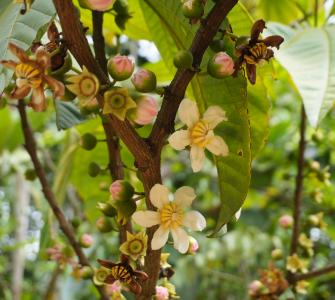
Tengkawang (Shorea spp.) is a high-value non-timber forest product (NTFP) native to West Kalimantan with significant potential as a raw material for the cosmetics and food industries. Despite being designated a provincial priority commodity by the Governor, its development is constrained by deep structural challenges: production relies almost entirely on wild harvest with no structured cultivation system, reliable data on tree distribution and production volumes is virtually nonexistent, and market access has weakened significantly following the exit of major buyers. On the regulatory side, smallholders and businesses face a complex web of overlapping permits (harvesting, transportation, processing), layered fees in the forestry sector, and administrative uncertainty that discourages investment and leads communities to shift toward faster-yielding crops. Cross-sector coordination among the relevant agencies remains fragmented, limiting the effectiveness of existing policy support.
In partnership with Koalisi Ekonomi Membumi (KEM), CSF led a Regulatory Impact Assessment (RIA) of the tengkawang value chain in West Kalimantan. CSF's role encompassed conducting a systematic desk review of regulations at the national, provincial, and district levels; carrying out field visits and key informant interviews with stakeholders including local government agencies, private sector actors, NGOs, and local; and analyzing regulatory bottlenecks to develop evidence-based policy options that can unlock the bioeconomy potential of tengkawang and NTFPs more broadly.
Our goal is for the RIA findings to serve as an evidence base for provincial and district governments to reform the regulatory environment for tengkawang and NTFPs more broadly, including through new gubernatorial regulations (Pergub), streamlined permitting procedures, and integration of tengkawang into regional development planning. The process is also intended to strengthen collaboration among government agencies, the private sector, NGOs, and local communities around a shared vision for a sustainable tengkawang bioeconomy in West Kalimantan.
The project contributes to the development of a sustainable, community-based bioeconomy in West Kalimantan's forests. By addressing the regulatory barriers that currently discourage tengkawang cultivation and trade, the project aims to create economic incentives for communities to conserve and regenerate forest landscapes rather than convert them to other land uses. In the longer term, a well-functioning tengkawang value chain supports forest conservation, indigenous and local community livelihoods, and Indonesia's broader commitments to sustainable forest management and green economic development.
This project was funded by Koalisi Ekonomi Membumi (KEM). Key local stakeholders engaged in the process included the West Kalimantan Provincial Government (DLHK, Dinas Koperasi UMKM, Bapperida), Tanjungpura University, Forestwise, NGO Intan, PRCF, GIZ, and local communities in Landak, Sintang and Bengkayang districts.
Photo: Flowering tengkawang (Shorea spp.), a native dipterocarp whose seeds give forest communities in Kalimantan Barat a reason to keep standing forests intact.
Photo credit: Triyoga Widiastomo (CSF Indonesia)