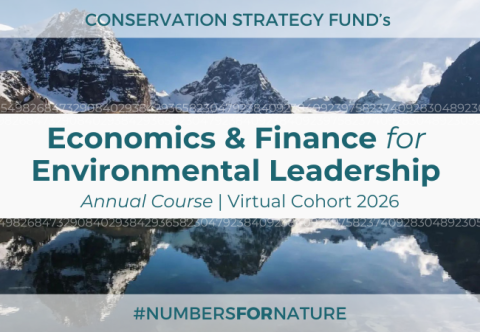
From September 14th to November 20th, Conservation Strategy Fund (CSF) will be hosting its 27th edition of Economics & Finance for Environmental Leadership, our flagship international course curated for environmental professionals from government and the public sector, to NGOs, academia, the private sector and multilateral institutions located globally and brought together through this fully virtual course.
Participants will cover a vast range of topics over ten weeks, beginning with fundamentals in environmental and natural resource economics, before moving on to explore economic tools and finance solutions to support their environmental work.
Format
Virtual: The course will be administered on the Numbers for Nature Training Institute platform, and will be taught by CSF's staff of expert instructors through a combination of pre-recorded lecture material, online readings and resources, and virtual live sessions over Zoom.
Regular Live Sessions: Virtual live sessions will occur twice a week, which will include deepened discussions over course material with instructors and classmates, exercises, and interactive community board posts. Diverse approaches such as small and large group discussions, case-study explorations, learning games, and more will be included in virtual live sessions to stimulate further learning and real life application in participant's respective fields.
Overall Commitment: The course will run for a 10-week period, with an estimated time commitment of 6 hours per week, including 2 virtual live sessions per week, pre-recorded lectures, and distributed readings and resources for class discussions. Seven modules will be offered through the course, each module containing 2 chapters.
The 7 modules will cover a diverse range of topics, including:
- Environmental Economics
- Fundamentals of economic and environmental economic concepts
- Return to the market basics: market failure, externalities, supply & demand, common resources, public goods
- Market Based environmental policies and solutions
- Natural Resource Economics
- Application of economics towards policy decisions of extraction and conservation of natural resources
- Resource valuation, property rights, common property and resources
- Time value of money and capital theory
- Environmental Valuation
- Natural capital and ecosystem health
- Methods of valuation to evaluate project development, ecosystem services, and conservation activities
- Importance of valuation and valuation methods
- Cost-Benefit Analysis
- Use and fundamentals of cost-benefit analysis as a support tool
- CBA processes, calculating indicators and feasibility, risk and sensitivity analysis, and equity considerations
- Financial analysis vs. economic analysis
- Conservation Finance
- Introduction and the taxonomy of conservation finance solutions
- Public and private sector finance options
- Economic instruments achieving financial efficiency and conservation goals
- Behavioral Economics
- Neoclassical vs. behavioral economics
- How human behavior predictably differs from traditional economic assumptions
- Using behavioral intervention to encourage positive environmental action
- Environmental Policy
- Economists' view of environmental and resource problems in a market economy
- Market-based incentives for managing the environment and optimizing cost
- Categories of environmental policy (voluntary, command and control, market-based)
- Lectures from renowned experts in environmental economics and conservation finance
- Expanded critical thinking for program development and project design
- A toolkit of economic analysis methods, including valuation and cost-benefit analysis
- An understanding of efficient policy decision-making towards conservation
- Utilization of market-based instruments towards environmental policy implementation
- Methods toward conservation solutions that are economically efficient
- An array of conservation finance solutions applying to the public sector, private sector, and multilateral institutions in participant's own work
- A network of environmental leaders within one's own cohort, and access to a network of more than 7,000 course graduates in 131 countries representing 3,000 organizations.
Learn more and enroll on CSF’s Numbers for Nature Training Institute here.