
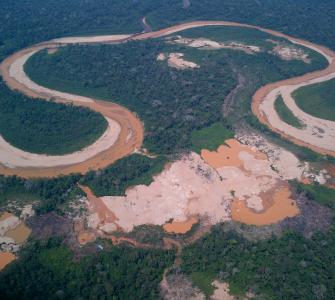
Environmental crimes have become one of the most profitable and complex illicit economies globally, with significant impacts on forests, biodiversity, public health, local communities, and governance. In the Amazon, and particularly along the Colombia–Peru border, illegal mining, illegal logging, land grabbing, deforestation, and associated illicit financial flows interact across jurisdictions, creating challenges that require coordinated institutional responses. The project’s workplan frames these crimes as part of broader transnational dynamics linked to organized crime, corruption, and weak enforcement capacity.
Implemented with WRI Colombia, this project sought to strengthen the capacity of competent authorities in Colombia and Peru to prevent, investigate, and sanction environmental crimes in the shared border region. The consultancy focused on developing a detailed diagnostic, an inter-institutional roadmap, and a set of operational tools to support more effective enforcement, coordination, and evidence-based decision-making.
CSF led the Colombian component of the work, contributing its experience in environmental economics, institutional analysis, geospatial interpretation, and practical tools for estimating environmental and economic damages. The methodology combined documentary review, analysis of open-source and geospatial information, interviews with key institutional actors, economic and environmental assessment tools, and technical validation spaces with relevant authorities. The work also remained aligned with parallel analysis in Peru, supporting the development of binational recommendations and practical mechanisms for transboundary cooperation.
The project produced a diagnostic of environmental crime dynamics in the Colombian Amazon with emphasis on the border with Peru, a preliminary operational roadmap for law enforcement in Colombia, technical workshops for validation and capacity building, and a final consolidated report with a binational roadmap. These outputs were intended to help authorities better understand priority crime chains, identify institutional bottlenecks, improve coordination between environmental, judicial, enforcement, and financial intelligence actors, and strengthen the use of data and economic evidence in environmental crime response.
By integrating economic analysis, geospatial monitoring, legal and institutional review, and participatory validation, the project aimed to support more coordinated, evidence-based, and actionable responses to environmental crime in one of the Amazon’s most sensitive transboundary regions.
Photo: Flickr/Minam Peru