
Cetaceans—whales, dolphins, and porpoises—are found in every world ocean. Several whale species migrate along the coastlines of entire continents between their summer and winter feeding grounds. In the past several years, the ecosystem services of cetaceans have been the focus of several studies in order to understand their value and impact on human and natural ecosystems.
Beyond their intrinsic value, cetaceans play a significant role in broader marine ecosystem services. Their excrement serves as a fertilizer for phytoplankton, facilitating their growth. Phytoplankton themselves contribute massively to the oxygen in our atmosphere through their own carbon capture. This nutrient cycling has broader impacts not only on carbon sequestration but on the nutrients available to fisheries.
Though much research has been conducted on ecological and biophysical contributions of cetaceans, less has been done translating these contributions into economic value. To facilitate the economic valuation of ecosystem services provided by cetaceans, CSF is conducting a pilot project based on one species/population and developing a framework to assess specific ecosystem service value for this and other cetacean species.
The provision of ecosystem services requires the whole ecosystem, which is not only defined by its components, but mainly by the interaction webs built within which species can potentially influence other species; these interactions can include both biological processes (e.g., competition, predation, and mutualism) and physicochemical processes (e.g., nutrients, impact on water limitation, and temperature). Therefore, species that play a role in supporting ecosystem functions and services at the same time depend on other species and abiotic elements in the ecosystem.
In the case of cetaceans, their role in contributing to support the provision of ecosystem services have gained interest in the past decade, with studies focusing mainly on ecological and biophysical analysis, which are the bases to conduct economic analysis. Yet, we acknowledge the still nascent understanding of the contribution of cetaceans to ecosystem services, especially with respect to carbon cycling. Given this, in this project we will utilize a conservative approach to estimating the potential value of these services, particularly with respect to carbon sequestration and nutrient cycling.
CSF worked closely with the IWC Secretariat, the IWC Conservation Committee Working Group on Cetaceans and Ecosystem Functioning and experts from the IWC Scientific Committee Standing Working Group on Ecosystem Modeling.
Working closely with the International Whaling Commission (IWC), CSF has produced:
- A Replicable Research Framework: A standardized methodology to assess the economic role of any cetacean population.
- Proven Case Studies: Real-world data showing that protecting whales is a high-return investment for coastal economies.
- Policy Guidelines: Strategies to integrate cetaceans into "Blue Carbon" markets and national climate goals, including proposals for a Global Cetacean Fund.
Key Findings
- The pilot study focused on the North Pacific humpback whale population (~26,500 individuals) and it revealed that this single population contributes an estimated $21.6 million USD annually in ecosystem services.
- The most significant economic contribution comes from the "whale pump": nutrient cycling that stimulates phytoplankton growth. This service alone is valued at an average of $20.4 million USD per year due to its role in increasing fisheries productivity.
- When whales die, their carcasses sink to the deep sea, sequestering carbon for centuries. This service for the North Pacific population is valued at approximately $1.2 million USD annually based on current carbon market shadow prices.
Policy Recommendations
- Include cetaceans within the framework of nature-based solutions. National climate policies should expand beyond mangroves and seagrasses to include the carbon-cycling and nutrient-distribution roles of marine megafauna.
- CSF proposes the creation of a "Global Cetacean Fund" that would allow for the monetization of these services (e.g., through carbon credits or fisheries levies) to fund whale conservation and compensate local communities for the costs of protection (such as gear changes to prevent entanglement).
- While CSF's current estimates are conservative, CSF's new methodological framework can b e applied to other species to build a global map of cetacean-driven economic value.
Having a better understanding of the role that cetaceans play in providing multiple benefits to people will provide a stronger voice for these marine mammals in the decision making table, catalyzing efforts to protect and restore their populations. This work will not only help cetaceans thrive, the framework we are developing can be applied to any species around our planet so we can work symbiotically with nature.
The project was funded by the International Whaling Commission.
__
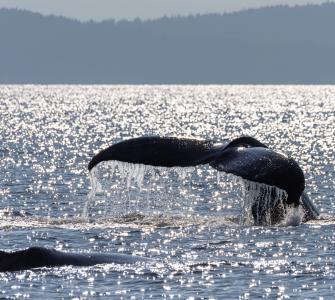
Photo: Humpback Whale, Vancouver by Marcello Hernández-Blanco