
Bridging Ridge to Reef: Innovative and Gender-Responsive Finance for Indonesia’s Land and Seascapes
As an archipelagic nation, Indonesia’s terrestrial and marine ecosystems are inextricably linked; land degradation directly accelerates the decline of vital coastal and marine environments. Recognizing this critical connection, the Government of Indonesia has prioritized the integrated management of terrestrial and coastal-marine areas.
The Solutions for Integrated Land and Seascape Management in Indonesia (SOLUSI) project was established to develop and implement ecosystem-based methods for integrated land and sea management across the country. Led by a consortium comprising GIZ, ICRAF, SNV, and Yayasan KEHATI Indonesia, the project employs a holistic "reef-to-ridge" approach. This framework emphasizes the interconnectedness between terrestrial zones, watersheds, and coastal marine environments to safeguard biodiversity, advance ecological restoration, and cultivate climate-resilient livelihoods.
To support this mission, Conservation Strategy Fund (CSF) was entrusted to conduct a comprehensive land and seascape finance assessment and design innovative investment strategies across three pilot provinces. These regions represent a diverse spectrum of ecological and economic landscapes, each presenting distinct investment challenges and opportunities:
- Bangka Belitung: Home to extensive marine conservation areas, yet heavily challenged by the environmental impacts of widespread tin mining.
- Central Sulawesi: A major producer of coffee and cacao, encompassing vital ecological reserves that harbor endemic flora, fauna, and critical water catchments.
- Central Java: Characterized by highly productive coastal natural resources interwoven with dense agricultural and manufacturing processing industries.
Through extensive stakeholder mapping and consultations with local communities, government units, and consortium partners, CSF analyzed current budget allocations, evaluated the efficacy of existing financial mechanisms, and identified untapped natural resource potential. The resulting strategies provide a actionable roadmap for scaling up sustainable development finance.
1) Innovative Land & Seascape Financing Strategy
Mobilizing and maintaining financial investments for massive ecosystems requires looking beyond the financial instruments themselves. Across the SOLUSI districts, successfully scaling up these instruments depends entirely on establishing core enabling conditions within local government systems to prevent mechanisms from remaining purely conceptual.
Key Takeaways & Enabling Conditions
Regulatory & Policy Frameworks
Local regulations and formal decrees must be enacted to legally ground Ecological Fiscal Transfer (EFT) mechanisms—such as TAPE (Territorial Ecological Fiscal Transfers), TAKE (Village Ecological Fiscal Transfers), or ALAKE (Ecosystem-based Alleviation Schemes)—and performance-based incentives. These financial tools must be directly integrated into official district planning and budgeting documents, including:
- RPJMD (Regional Medium-Term Development Plan)
- RKPD (Regional Government Work Plan)
- OPD Strategic Plans (Regional Government Department Plans)
Aligning these mechanisms with annual fiscal budgets eliminates structural audit and legal risks, transforming temporary initiatives into permanent statutory line items.
Institutional Coordination
Innovative financing requires breaking down traditional bureaucratic silos. The report highlights the critical need for a dedicated, district-level Innovative Finance Team (anchored within Bappeda or Pokja SOLUSI) to bring together planning agencies, environmental departments, village representatives, and financial intermediaries like regional development banks.
Technical Capacity Development
Local technical expertise remains a significant bottleneck. Future efforts must prioritise hands-on learning—such as mentoring and pilot-based applications—over standard workshops. Training must focus on green project pipeline preparation, financial structuring, and robust Monitoring, Reporting, and Verification (MRV) systems.
Political Continuity Management
Because environmental strategies span multiple political cycles, financing approaches must be institutionalised long-term by embedding them directly into OPD performance indicators and formal inter-agency agreements to mitigate political and fiduciary risks.
2) Gender-Responsive Financing Mechanisms
While the pilot provinces possess foundational policy frameworks for gender mainstreaming, the implementation of truly gender-responsive sustainable finance remains in its infancy. Local government agencies frequently view Gender-Responsive Budgeting (GRB) as a rigid administrative hurdle rather than an optimization strategy for public spending. Consequently, tools like the Gender Analysis Pathway (GAP) and Gender Budget Statements (GBS) are rarely woven systematically into environmental development cycles.
Furthermore, a significant institutional capacity gap exists. Cross-sectoral approaches between technical environmental agencies (fisheries, agriculture, energy, forestry) and departments responsible for gender empowerment are rarely integrated, resulting in fragmented, exclusionary interventions.
Overcoming Structural Barriers for Women
Women in the pilot regions face intersecting structural barriers that limit their capacity to lead or participate in green economic activities, such as biodiversity conservation, waste management, renewable energy, and sustainable agriculture.
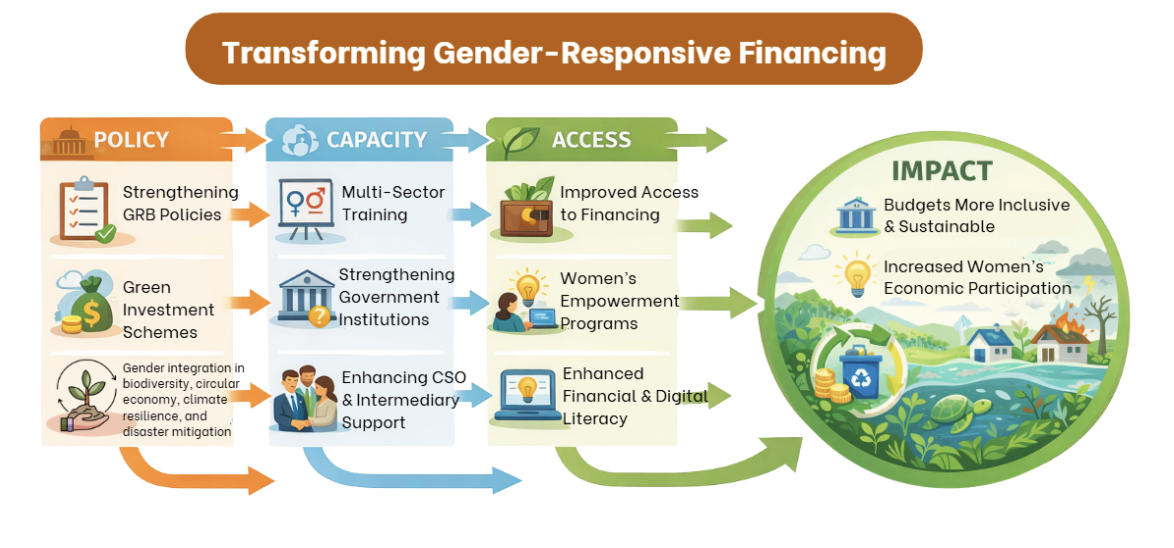
Strategic Recommendations
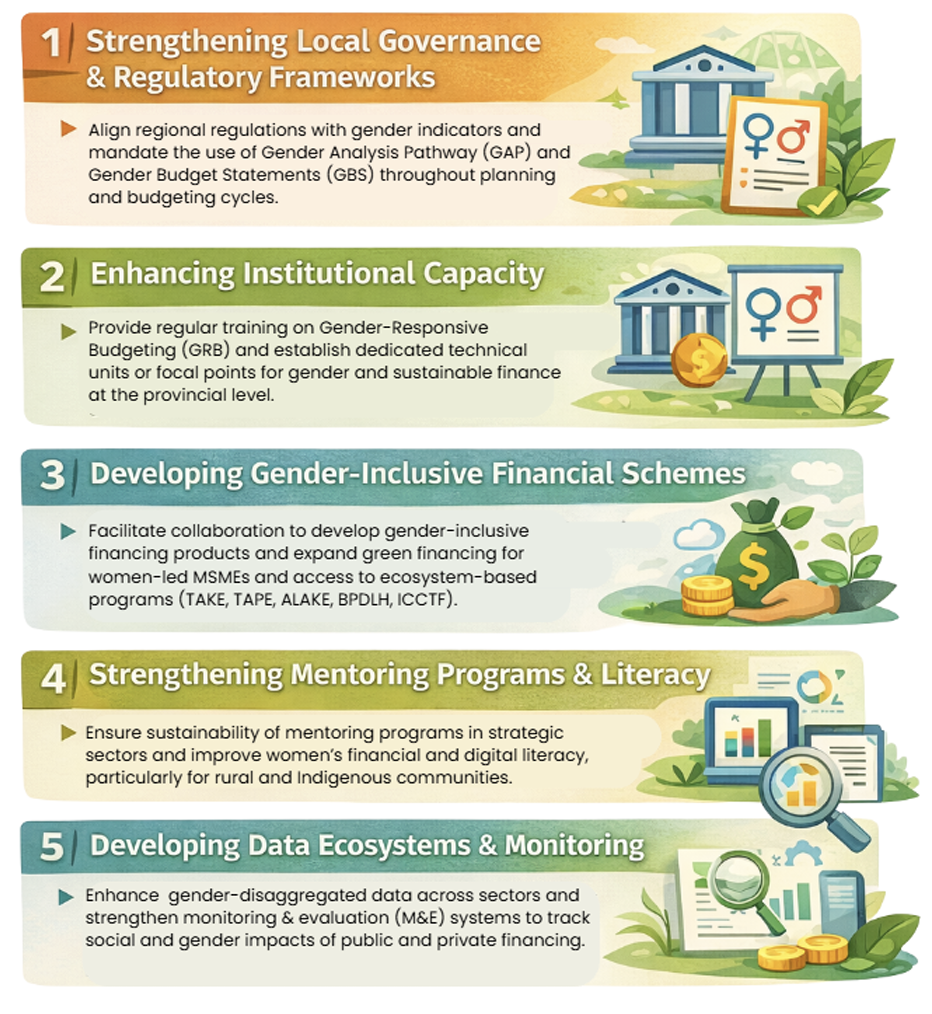
To shift women from passive beneficiaries to active decision-makers and economic leaders in Indonesia's green transition, the report outlines five integrated strategic interventions:
Looking Forward
By embedding both structural financial innovations and gender equity directly into sub-national governance architectures, Central Java, Central Sulawesi, and Bangka Belitung have a unique opportunity to lead. Active collaboration among government bodies, financial institutions, civil society organizations, and local communities will determine the success of these strategies.
Implementing these integrated roadmaps allows these provinces to transcend isolated pilot projects, demonstrating how aligned sub-national financing systems can drive systemic, scalable, and transformative climate policy pathways for Indonesia.
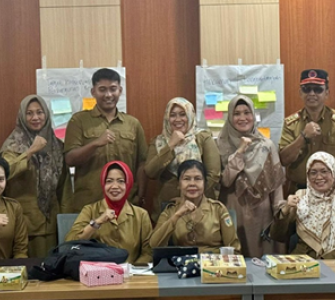
This project concluded with dissemination activities, in which CSF Economist, Triyoga Widiastomo, presented the findings in three pilot sites of Central Java, Central Sulawesi, and Bangka Belitung.
Photo: CSF Indonesia